Damascus, Syria
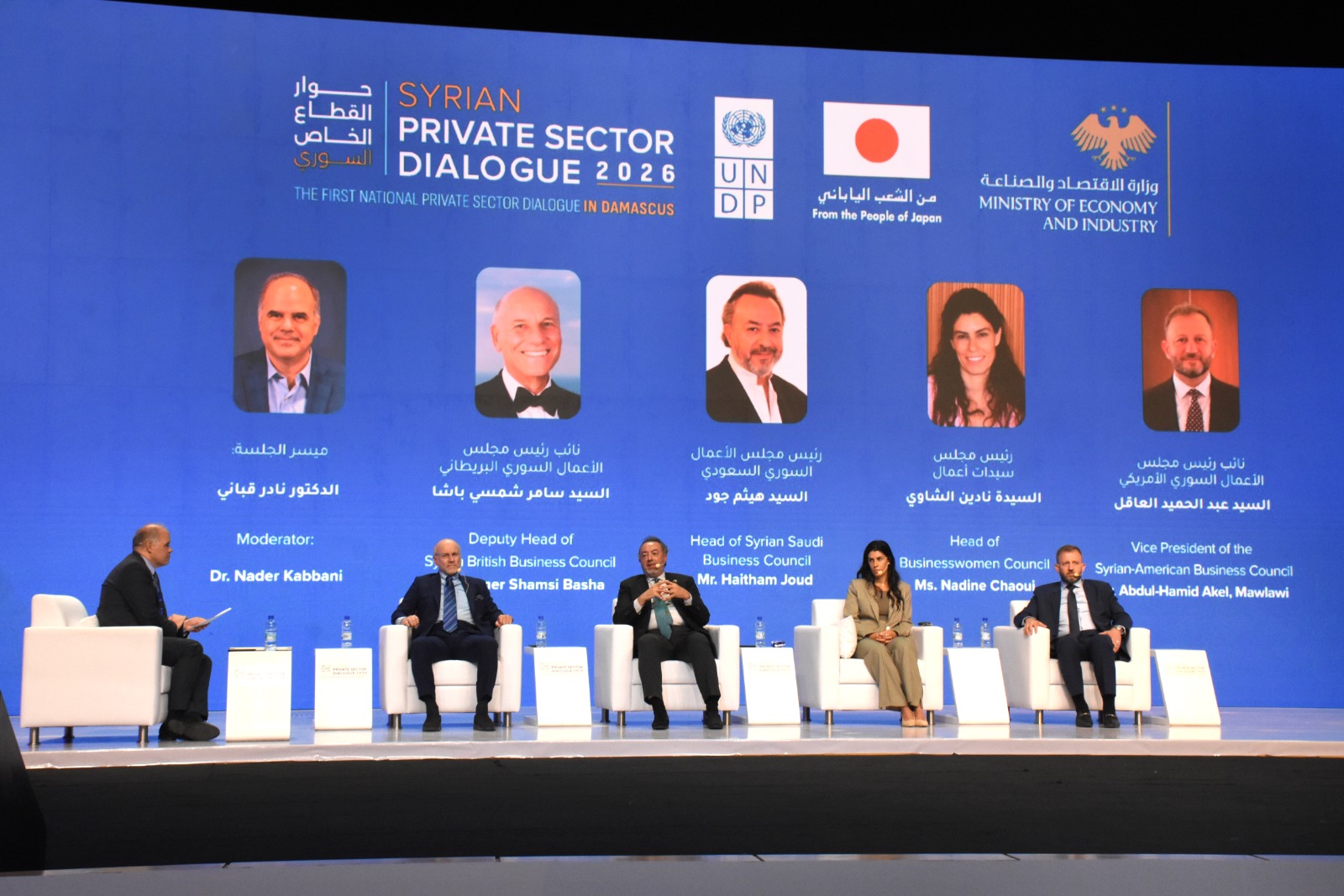
The Syrian Saudi Business Council participated in the Syrian Private Sector Dialogue National Conference PSD 2026 held in Damascus, joining senior government officials, business leaders, international organizations, development institutions, and investors in shaping a shared vision for Syria’s economic recovery and sustainable development.
The conference served as an important national platform to discuss the role of the private sector in accelerating economic growth, stimulating investment, creating employment opportunities, and strengthening collaboration between public institutions, local and international investors, and development partners.
Plenary Session: Private Sector as a Driver of Growth
As part of the Council’s participation, Mr. Haytham Subhi Joud, Council President of the Syrian Saudi Business Council, took part in the main plenary session entitled “What the Private Sector Can Do to Support Economic Recovery and Development Objectives.”
During his intervention, Mr. Joud emphasized that the private sector is not merely a beneficiary of economic recovery but a principal driver of growth, investment, innovation, and job creation. He highlighted the importance of strengthening public private partnerships, enhancing the business environment, and enabling productive investments capable of supporting Syria’s long term development objectives.
Strategic Side Events and Investment Certainty
The Council was also represented in two strategic side events by Mr. Muntaser Kalahji, Deputy Chief Executive Officer of the Syrian Saudi Business Council.
In the session entitled “Priority Sectors for Investment: Investing in Syria,” organized by the Syrian Investment Authority, Mr. Kalahji discussed the key conditions required to attract serious investment and transform investor interest into tangible projects on the ground.
He stressed that investors primarily seek confidence, predictability, and a clear regulatory framework before considering incentives and exemptions. He noted that Syria possesses significant competitive advantages, including its strategic geographic location, skilled human capital, established industrial base, and substantial opportunities across manufacturing, infrastructure, agriculture, energy, and services.
Mr. Kalahji further emphasized that accelerating investment flows requires continued efforts to simplify procedures, strengthen legal and regulatory certainty, improve access to financing, and develop a pipeline of bankable projects supported by reliable data and feasibility studies. He underscored the importance of creating an enabling environment that allows investors to move efficiently from preliminary discussions and memoranda of understanding to implementation and operational execution.
Drawing on the experience of the strategic partnership between the Syrian Sovereignty Fund and Riyadh Cables Company to modernize and operate Syrian Modern Cables SMC, Mr. Kalahji highlighted the value of partnerships that combine local assets, regional expertise, technology transfer, and long term investment commitments as practical models for accelerating economic recovery and industrial revitalization.
Economic Reintegration and Sustainable Return
In a second side event hosted by UNHCR under the title “From Return to Recovery: Private Sector Engagement with Returnees,” Mr. Kalahji addressed the critical relationship between economic opportunity and sustainable return.
He emphasized that successful reintegration of returnees requires moving beyond humanitarian support towards productive economic participation. In this context, he highlighted the private sector’s role in creating employment opportunities, supporting entrepreneurship, facilitating vocational training, and integrating returnees into productive sectors of the economy.
Mr. Kalahji stressed that returnees should be viewed not only through a humanitarian lens but also as valuable contributors to Syria’s recovery, bringing skills, experience, entrepreneurial capabilities, and international exposure that can strengthen the country's economic transformation.
He also called for stronger collaboration between government institutions, the private sector, international financial institutions, and development organizations to establish integrated frameworks that support skills development, SME growth, access to finance, and workforce integration. Furthermore, he emphasized the importance of mobilizing blended finance mechanisms, investment guarantees, and development financing tools to reduce investment risks and enable larger scale private sector participation in recovery and job creation initiatives.
Commitment to Regional Economic Cooperation
Throughout the conference discussions, the Syrian Saudi Business Council reaffirmed its commitment to supporting Syria’s economic recovery through investment promotion, industrial development, private sector empowerment, and enhanced regional economic cooperation.
The Council believes that sustainable recovery will be driven by productive investment, competitive industries, entrepreneurial growth, and meaningful public private partnerships capable of creating employment opportunities and improving livelihoods across Syria.
The Syrian Saudi Business Council remains committed to serving as a bridge for economic cooperation and investment between Syria and the Kingdom of Saudi Arabia, while contributing to initiatives that foster sustainable growth, economic resilience, and long term prosperity.